Exodontia.info
Menu
Exodontia.info
✕
info@exodontia.info

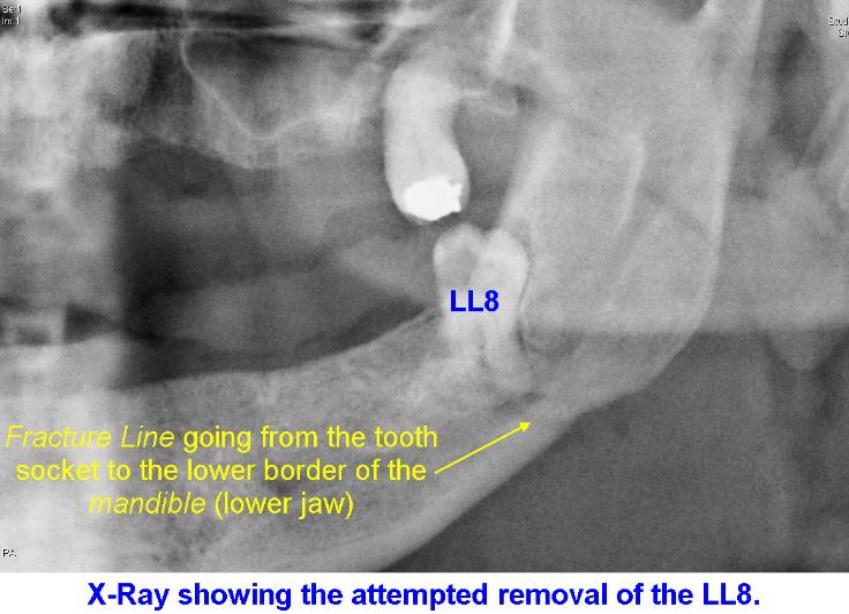
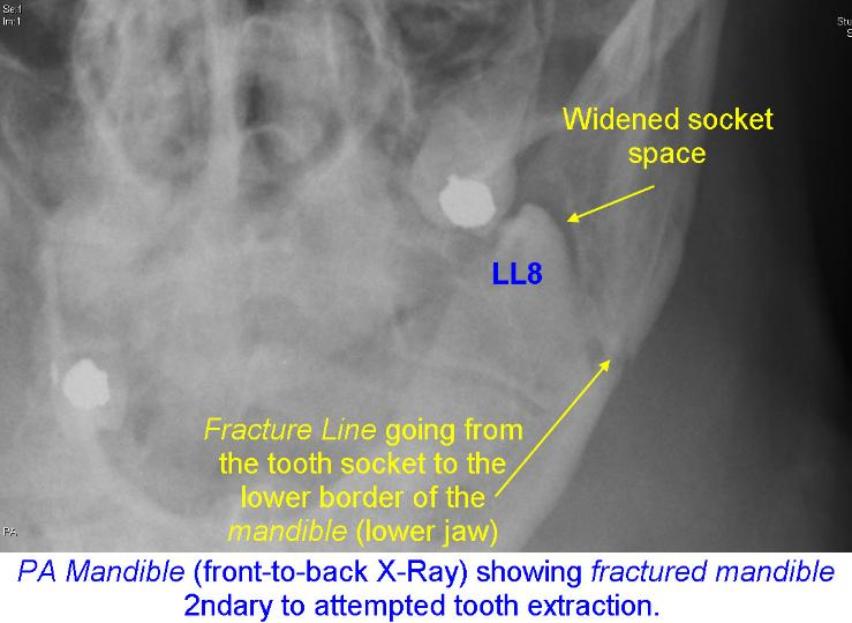
Fractured Upper / Lower Jaw secondary to Tooth Removal

Incidence: 2 – 4% (including alveolar and lingual plate fractures, so the incidence of actual fractures of the upper and lower jaws is likely to be much less. Some studies have cited 0.0049% and also 0.29%).

This is probably the most feared of all complications following Minor Oral Surgery and like the majority of them, is largely preventable. It is a recognised complication of lower wisdom tooth removal and should be listed as such on a routine consent form.

Fracture of the mandible / lower jaw is a very unpleasant but fortunately rare complication that is associated almost exclusively with the extraction of impacted lower wisdom teeth.

The peak incidence is in patients over 25 years of age with a mean of 40 years. As men have a greater masticatory (chewing) force, men are thought more likely to have ‘late’ fractures (these occur 13 – 21 days post-op).

There are a number of predisposing conditions, such as:

  • use of excessive force with the dental elevator, when an adequate pathway for removal of the impacted tooth has not been created
  • mandibular atrophy (reduced height and width of jaw)
  • deeply impacted tooth
  • a tooth with ‘firm anchorage’ / bulbous roots / hypercementosis (increased thickness of root cement)
  • extensive œdentulous (toothless) regions
  • an ankylosed (fusion of tooth with surrounding bony socket) tooth
  • osteoporosis and
  • the presence of associated pathology such as a cyst (dentigeous cyst) or tumour (ameloblastoma).
Tooth Related Jaw Fractures

Useful Articles & Websites

J Oral Maxillofac Surg 2000. Late Mandibular Fracture After 3rd Molar Surgery. A Survey of Connecticut Oral & Maxillofacial Surgeons

J Oral Maxillofac Surg 2000. Mandibular Fracture After 3rd Molar Removal

J Oral Maxillofac Surg 2000. Discussion. Mandibular Fracture After 3rd Molar Removal

J Oral Maxillofac Surg 2002. Immediate & Late Mandibular Fractures After 3rd Molar Removal

J Can Dent Assoc 2004. The Association of 3rd Molars with Mandibular Angle Fractures. A Meta-Analysis

J Can Dent 2004. Third molars may double the risk of an angle fracture of the mandible

EBD 2004. 3rd Molars may double the risk of an angle fracture of the mandible

J Oral Maxillofac Surg 2010. Prevention of Mandibular Fractures Caused by Difficult Surgical Extractions. Report of a Borderline Case

BJOMS 2011. Characteristics of Iatrogenic Mandibular Fractures associated with Tooth Removal. Review & Analysis of 189 cases

BDJ 2012. Iatrogenic Mandibular Fractures Following Removal of Impacted 3rd Molars. An Analysis of 130 cases

BDJ 2016. Letters to the Editor. Oral Surgery. Mandibular Fracture Risk

Dent Update 2016. A Pathological Fracture of the Mandible due to Osteomyelitis following a Full Dental Clearance

  • Cookie Policy
  • Privacy Policy
  • Terms & Conditions
  • Disclaimer
  • Adverts & Sponsors Policy
  • Contact Details

Copyright @ Exodontia - All things Oral Surgery 2026

Website by Hotgrafix

✕
  • Home
  • What is Oral Surgery?
  • Dental Nerve Injuries
  • Wisdom Teeth
    • Wisdom Teeth Removal Guidelines
    • Wisdom Teeth Treatment Options
    • Impaction Classification
    • Indices of Difficulty
  • Oral Surgical Procedures
    • Tooth Removal Warnings
    • What is a Biopsy?
    • Biopsy Warnings
    • Pericoronitis
    • Operculectomy
    • Coronectomy
    • Fraena & Tongue Ties
    • Ectopic & Extra Teeth
    • Exposing & Bonding of Brackets to Teeth
    • Apicectomy Explanation
    • Apicectomy & Retrograde Root Filling (RRF) Warnings
    • Cryotherapy
    • Fractured Maxillary Tuberosity
    • Maxillary Tuberosity Reduction
    • Mouth-Sinus Holes (Oro-Antral Communications)
    • Closure of Mouth-Sinus Holes
    • Buccal Flaps
    • Palatal Flaps
    • Buccal Fat Pad Repair
    • Alveoplasty
    • Removal of Tori
    • Caldwell-Luc / Intra-Oral Antrostomy
  • Post-op Instructions
    • Oro-Antral Regime
    • Post-Op Extraction Instructions
    • Post-op Biopsy Instructions
    • Post-Op Pain Control
  • Bleeding Problems
    • Bleeding Sockets
    • Coagulopathy Post-op Advice
  • Lumps, Bumps & ‘Patches’
    • Drugs for Oral Conditions
    • Amalgam Tattoo
    • Geographic Tongue
    • Black Hairy Tongue
    • Epulides
    • FEP’s & Oral Fibromata
    • Peripheral Ossifying Fibroma
    • Squamous Papilloma
    • Oral Frictional Hyperkeratosis (FK)
    • Oral Mucocœles
    • Oral Candidiasis
    • Denture Stomatitis
    • Median Rhomboid Glossitis
    • Angular Cheilitis
    • Papillary Hyperplasia of the Palate
    • Candidal Leukoplakia
    • Apical Granuloma
    • Parulis
    • Peri-Apical Cysts
    • Dentigerous Cyst
    • Odontogenic Keratocyst (OKC)
    • Solitary Bone Cyst
    • Aneurysmal Bone Cyst
    • Smoker’s Keratosis
    • Oral Aphthous Ulceration
    • Desquamative Gingivitis
    • Plasma Cell Gingivitis
    • Oral Lichen Planus
    • Pemphigus
    • Bullous Pemphigoid
    • Cicatricial Pemphigoid
    • Linear IgA Disease
    • Chronic Ulcerative Stomatitis
    • Drug-Induced Gingival Hyperplasia
    • Necrotising Sialometaplasia
    • Odontomes
    • Exostoses & Tori
    • Dense Bone Islands
    • Oral Blood Blisters
    • Oral & Lingual Tonsils
    • Pre-Malignant Lesions
    • Actinic Cheilitis
    • Oral Sub-Mucous Fibrosis
    • Oral Leukoplakia
    • Oral Cancer
      • Oral Cancer – Ætiological Factors
      • Oral Cancer – Oral Examination
      • Oral Cancer – Oral Screening
      • Oral Cancer – Rapid Referral
      • Oral Cancer – Role of GDP
    • Erythroplakia / Erythroplasia
    • Oral Mucositis
  • Dental Implants
    • Going Abroad for Dental Implants
    • Dental Implant Warnings
  • Oro-Facial Infections
    • Dry Socket
    • Osteomyeltis
    • Cervico-Fascial Infection
  • Mouth & Face Pains
    • Acupuncture
    • Atypical Odontalgia
    • Atypical Facial Pain
    • Burning Mouth Syndrome
    • Trigeminal Neuralgia
    • Post-Herpetic Neuralgia
    • Cranial / Temporal Arteritis
    • Trigeminal Sensory Neuropathy
    • Numb Chin Syndrome
    • Eagle Syndrome
    • Zinc Deficiency
  • Jaw Joint Problems
    • TMJ Arthrocentesis
    • Jaw Dislocation
    • Remedial Jaw Exercises
    • Clicking TMJ Exercises
    • Illustrated TMJ Exercises
    • Self-Care for TMJ Pain
    • Temporalis Tendonitis
    • Tooth Grinding
  • Surgical Dermatology
    • Scars & Their Treatment
    • Steroid Injections Into Scars
    • Seborrhœic Keratosis
    • 5-Fluorouracil, 5-FU, Efudix
    • Post-Op Instructions
  • Bleeding Diatheses & Oral Surgery
    • Coagulopathies & Oral Surgery
    • Warfarin & Oral Surgery
    • Anti-Thrombotics & Oral Surgery
    • NOAC’s & Oral Surgery
    • Platelet Disorders & Deficiencies
    • Hæmophilia & Oral Surgery
    • Rare Clotting Factor Deficiencies
    • Hæmatological Disorders
    • Dialysis & Oral Surgery
  • Salivary Gland Disorders
    • Dry Mouth & Xerostomia
    • Sjögren’s Syndrome
    • Minor Salivary Gland Biopsy (for Sjögren’s Syndrome Diagnosis)
    • Parotid Gland Removal / Superficial Parotidectomy
    • Submandibular Gland Removal
    • Sublingual Gland Removal
    • Ranulas / Ranulæ & Their Treatment
    • Sialosis / Sialadenosis
    • Frey’s Syndrome / Gustatory Sweating
    • Salivary Stone Release
    • Taste Disturbances
  • Dental & Facial Trauma
    • Dental Emergencies & Trauma
    • Facial Trauma
    • Fractures of the Mandible / Lower Jaw
    • Fractures of the Cheek Bone / Zygomatic Complex
    • Archbars & Buttons Removal
  • Oral Surgery & Pregnancy
  • Local Anaesthetic Allergy & Testing
  • Find A Dentist
  • Find An Endodontist
  • Membership & Links
  • Bibliography
  • Biography