
Limitation of Mouth Opening (Trismus)
Trismus is a painful condition that restricts normal mandibular movement and function as a result of masticatory musculature spasms. Patients are unable to open their mouth within the normal range (35 to 55 mm [average is 40 mm]; 3-finger wide).
Trismus is diagnosed from clinical examination of the Maximal Inter-Incisal Distance (MID) of less than 40 – 45 mm caused by contracture of the masticatory musculature and not by obstructive joint impingement.
This represents the distance from the incisal edge of the maxillary (upper jaw) and mandibular (lower jaw) incisors. In œdentulous (toothless) patients, it is measured between the maxillary and mandibular alveolar ridges of less than 40 – 45 mm will be classified as trismus.
Evidence suggests that gender may be a factor in vertical mandibular opening. In general, males display greater mouth opening
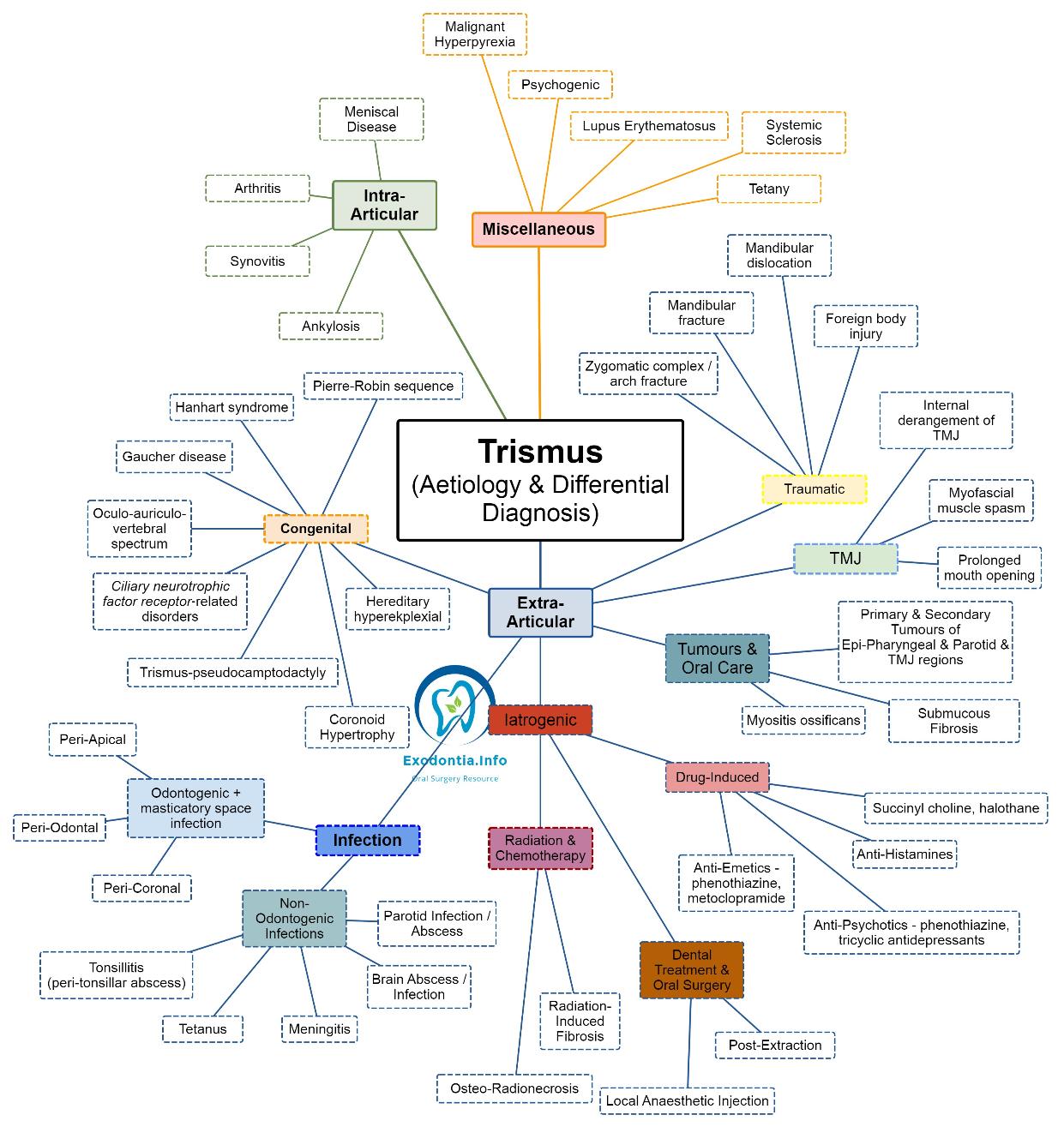
In general, all conditions resulting in an impaired ability to open the mouth within a normal range is classified as trismus.
Trismus has a number of potential causes, which range from the simple and non-progressive to those that are potentially life-threatening.
Trismus can have consequences including impaired mastication (chewing), difficulty in speaking, in achieving adequate oral hygiene and in access for oral care. If left untreated, degenerative processes in the masticatory muscles, with disuse atrophy, may ensue.
Signs
- Limited mouth-opening ability
- Deviation of the jaw toward the affected side (muscles not functioning properly because of spasms)
- Diffuse facial swelling and fever (only if associated with infections)
- Pain severity: severe pain in acute condition (if there are trigger points in muscles); dull, aching pain if muscle spasms persist for a long time
Symptoms
- Pain at rest
- Difficulty to open the mouth wide and attain full-range motion
- Inability to chew or bite on solid foods
- Discomfort when yawning
- Difficulty to brush teeth and follow routine oral hygiene care, which can lead to bad breath and a high risk of caries
- Pain in one or more masticatory (chewing) muscles
- Sensation of muscle tightness, cramping, or stiffness
- Difficulty with respect to speech; inability to receive proper dental care
Investigation
Rule Out Other Pathologies
- Thoroughly review the patient’s dental and medical history
- Ask about the onset, nature, progression, aggravation, radiation of pain and relieving factors
- Ask about any dental treatment, joint clicking and locking, trauma, infections, medical conditions, radio-therapy or drug intake
- Inquire about pain in neck, shoulder and back muscles
- Inquire about sleep bruxism (clenching / grinding / tooth tapping) or daytime para-function (clenching / gum chewing / fingernail biting)
- Perform a complete extra-oral and intra-oral examination
- Check for visible muscle fasciculation (pathognomonic for myo-spasm / trismus diagnosis)
- Check for facial asymmetry
- Measure maximum mouth opening (check for inter-incisal distance) and lateral range of jaw motion
- Palpate the masticatory muscles and check for tenderness (some areas may be extremely tender due to deep pain input from myo- fascial trigger points)
- Palpate the neck muscles (especially sterno-cleidomastoid muscle) and upper shoulder muscles (trapezius)
- Examine the tempero-mandibular joint (TMJ) (check for any tenderness, uncoordinated movement, clicking sounds and crepitus)
- Look for partially erupting 3rd molars and gingival inflammation
- Check teeth for any wear facets and / or occlusal disharmony
- Perform a radiographic investigation.
- Panoramic radiographs may be advisable to look for any associated abnormalities with TMJ’s.
- CT and MRI scans may be required to rule out pathologies in structures such as TMJs, ears, etc.
Diagnosis
Based on the clinical history and signs, a diagnosis of trismus is determined.
Possible Causes
- Facial trauma with / without bone fracture
- Non-odontogenic infections (tonsillitis, meningitis, tetanus, parotid abscess): trismus is a hallmark of masticatory-space infections and may also occur along with pericoronitis
- Needle stick injury to the medial pterygoid muscle
- Fibrosis (when masticatory muscles are involved in field of radiation)
- Prolonged mouth opening (following any dental procedure like dental extraction / high points after dental restoration)
Treatment
Treatment (including patient education, self-care management, rest and analgesics) should be directed towards the underlying causes.
- Partially impacted tooth: extraction of offending tooth may be required
- Infection: antibiotic therapy
- Trauma: referral to an Oral Surgeon / Oral & Maxillofacial Surgeon
Common Initial Treatments
- Advise the patient to follow a soft diet and avoid solid foods
- Suggest heat therapy (placing moist hot towels on the affected area for 15-20 minutes every 1 hr)
- Suggest taking analgesics: Paracetamol, .5 – 1g every 4 – 6 hours or Ibuprofen 200 – 400 mg every 4 – 6 hours
- Muscle relaxants may be used in combination with analgesics or alone. Benzodiazepines may also be used, such as diazepam (2 – 5 mg, 3 times / day)
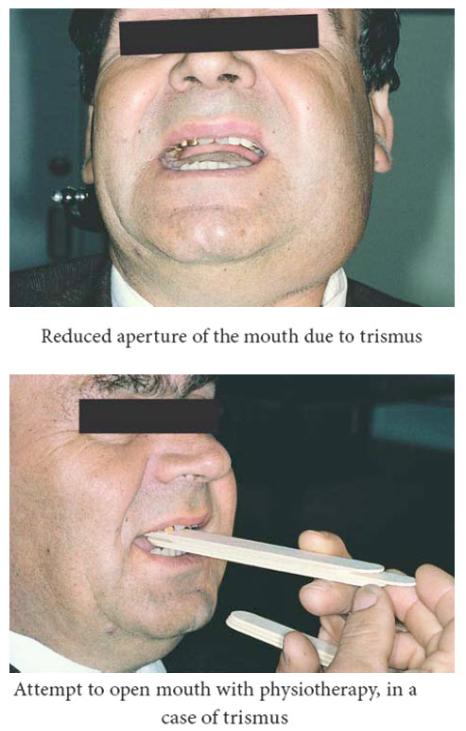
- Physiotherapy treatments may be required to establish normal function (exercises will include neck stretching, chin tuck, massaging of masticatory muscles and other jaw stretching)
- Mandibular opening devices might be considered in some cases, but most likely provided by a physiotherapist or dental specialist
Advice
Patients should:
- Rest
- Avoid any daytime jaw parafunction (gum chewing, finger nail biting, tooth clenching, etc.)
- Work with a physiotherapist to strengthen their jaw muscles, if needed (in acute conditions)


Useful Articles & Websites
Dental Update 2002. Trismus – Aetiology, Differential Diagnosis and Treatment
Oral Surg Oral Med Oral Pathol Oral Radiol Endod 2004. Clinico-Pathologic Conference. Trismus following Dental Treatment
Br J Oral Maxillofac Surg 2005. Possible Link between Extraction of Wisdom Teeth & Temporomandibular Disc Displacement with Reduction
J Oral Maxillofac Surg 2005. Limited Painful Mouth Opening
J Oral Sci 2009. Treating Trismus with Dynamic Splinting – A Case Report
Br J Oral Maxillofac Surg 2010. Technical note. Battling trismus – the “Pat-Bite” device
Br J Oral Maxillofac Surg 2011. Reliability & validity of a new method of nurse-led assessment of trismus
BMJ Case Reports 2015. Trismus, the first symptom in a challenging diagnosis of Tetanus
Cochrane Library 2016. Interventions for preventing & treating trismus in patients with head & neck cancer
Int J of Oral Health Med Res 2016. Intricate Role of Trismus Appliance in Dental Perspectives A Comprehensive Cum Technical Revelation
BMJ Open 2018. Protocol for the Trismus Trial – Therabite vs Wooden Spatula in the Amelioration of Trismus in Patients with Head & Neck Cancer – Randomised Pilot Study
J Pharm Res 2018. Trismus – A Review
Oral Health Care 2018. Trismus caused by Pterygomandibular Raphe Rigidity – A Case Report & Systematic Review