
Exodontia.info
Menu
Exodontia.info
✕
info@exodontia.info

Cavernous Sinus Thrombosis

Cavernous Sinus Thrombosis (CST) is a rare, life-threatening disorder that can result from facial infections, sinusitis, orbital cellulitis, pharyngitis or otitis or following traumatic injury / surgery, especially in the setting of a thrombophilic disorder.

Early recognition of CST which, often presents with fever, headache, eye findings such as peri orbital swelling & ophthalmoplegia, is critical for a good outcome.

Despite modern treatment with antibiotics & anti-coagulation, the risk of long-term sequelae, such as vision, diplopia & stroke, remains significant.

Causes:

CST is usually septic, but can also be aseptic. Septic cases can follow central facial infections, especially within the “danger triangle” of the face (from the corners of the mouth to the bridge of the nose). These include abscess or cellulitis, sinusitis (especially sphenoiditis and ethmoiditis), dental infections, extractions or procedures (even a posterior superior alveolar nerve block entering the pterygoid plexus), maxillofacial surgery, otitis media & mastoiditis.

Aseptic causes are less common than septic causes. These include trauma, surgery or pregnancy.

A variety of infectious organisms can cause CST although the majority are bacterial. Fungal infection in CST is less common. Rarer still are parasites (such as toxoplasmosis, malaria & trichinosis) as well as viruses (such as herpes simplex, cytomegalovirus, measles, hepatitis & HIV).

Immunosuppression, such as uncontrolled diabetes, steroid use, cancer or chemotherapy, maybe a risk for not only developing CST but also developing complications.

The biggest risk factors are facial infections, acute sinusitis & peri-orbital infections. Thrombophilia is a significant risk factor for CST.
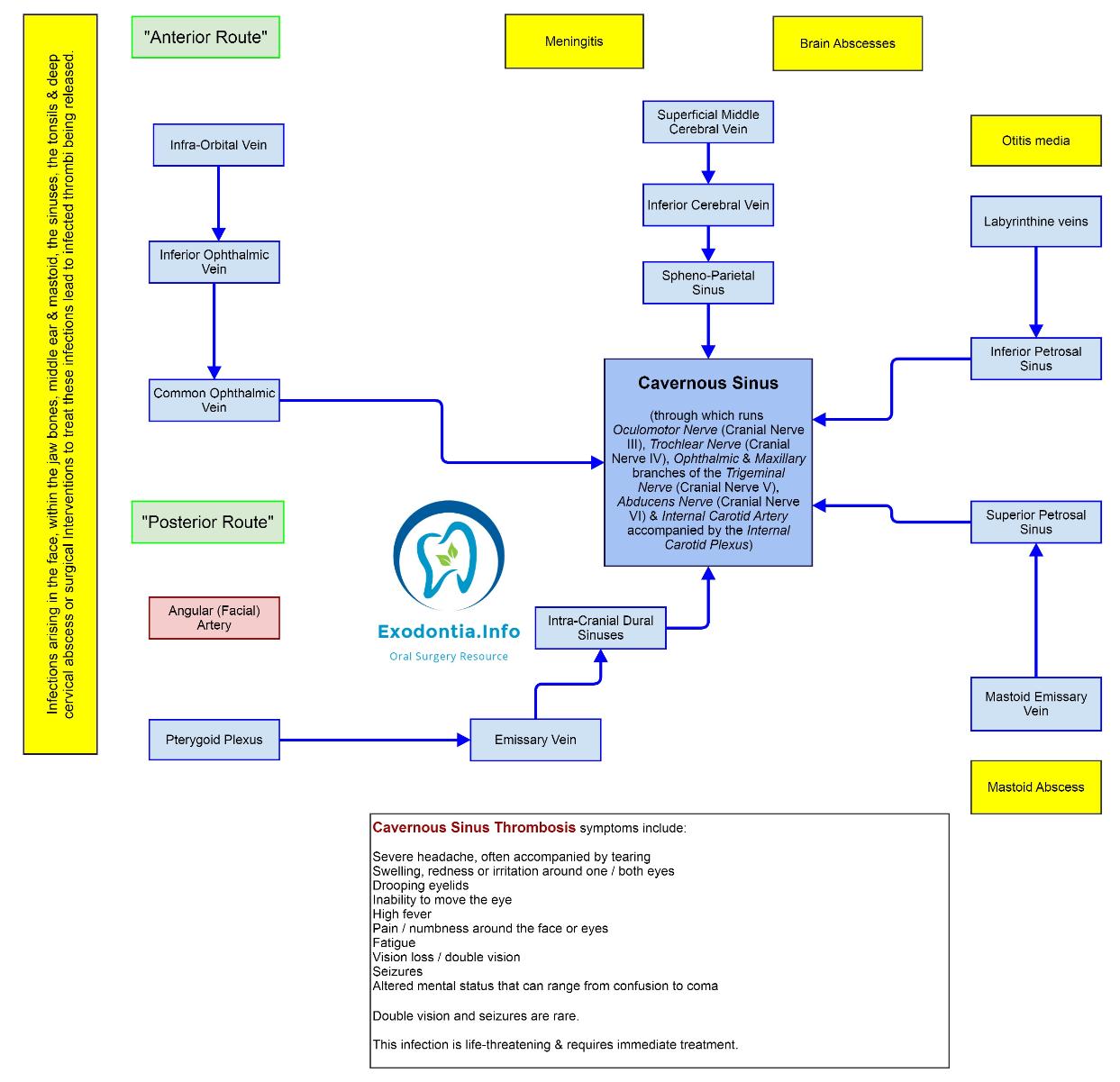
Cavernous Sinus Thrombosis

How CST Happens:

The mechanism is due to:

  1. Embolisation of bacteria & other infectious organisms which trigger thrombosis which then can trap infection within the Cavernous Sinus.
  2. CST leads to decreased drainage from the Facial Vein & Superior & Inferior Ophthalmic Veins resulting in facial & peri-orbital œdema, ptosis, proptosis, chemosis, discomfort & pain with eye muscle movement, papillœdema, retinal venous distention & loss of vision. Lack of valves in the dural sinus system allows flow through the emissary veins into & out of the Cavernous Sinus & thrombus can propagate into the dural system. Also, communication between the right & left cavernous sinuses via the inter-cavernous sinuses, anterior & posterior to the sella, allows the spread of thrombus & infection from one side to the other.

Local compression & inflammation of cranial nerves can lead to several partial / complete cranial neuropathies including:

  • Diplopia from partial / complete external ophthalmoplegia due to compression of the VI (Abducens), III (Oculomotor) and IV (Trochlear) cranial nerves. Limited eye abduction from Abducens palsy is most common early finding, often progressing to inability to move the eye in any direction when III, IV and VI cranial nerves are involved
  • Internal ophthalmoplegia (non-reactive pupil) occurs from loss of sympathetic fibres from the short ciliary nerves (resulting in miosis) and / or from loss of para-sympathetic fibres from cranial nerve III (resulting in mydriasis)
  • Anæsthesia / paræsthesiæ (around the eyes, nose, forehead) & loss of corneal blink reflex from the Ophthalmic Nerve, a branch of the Trigeminal Nerve (V)
  • Facial pain, paræsthesiæ / anæsthesia from compression of the maxillary branch of the Trigeminal Nerve.
  • Septic Cavernous Venous Thrombosis can result in the central nervous system or infectious pulmonary complications.

Because the dural venous & cavernous system is valveless, this venous blood can communicate with the dural sinuses & cerebral & emissary veins leading to meningitis, dural empyema or brain abscess.

Infection can spread via the jugular vein to the pulmonary vasculature resulting in septic emboli or abscess, pneumonia or empyema.

Stroke can occur following carotid artery narrowing, vasculitis, or haemorrhagic infarction following progression to cortical vein thrombosis.

Hypo-pituitarism can occur due to ischaemia or the direct spread of infection.

Cavernous Sinus Thrombosis

Useful Articles & Websites

Skull Base Surgery 1996. The Spectrum of Cavernous Sinus & Orbital Venous Thrombosis. A Case & A Review

JRMS 2010. Cavernous Sinus Thrombosis as a Fatal Complication of a Dental Abscess – A Case Report

J Med Assoc Thai 2010. Bilateral Septic Cavernous Sinus Thrombosis Following the Masticator & Parapharyngeal Space Infection from the Odontogenic Origin. A Case Report

BJOMS 2011. Short Communication. Septic thrombosis of the cavernous sinus & dental infection

JOMS 2013. Cavernous Sinus Thrombosis as a Result of a Fungal Infection. A Case Report

Nat J Maxillo Surg 2013. Bilateral Cavernous Sinus Thrombosis & Facial Palsy as Complications of Dental Abscess

Romanian Neurosurgery 2014. Massive Infarction & Cavernous Sinus Thrombosis. An Uncommon Complication of Tooth Extraction

Int J Clin Exp Med 2016. Cavernous Sinus Thrombosis of Odontogenic Origin

J Korean Assoc Oral Maxillofac Surg 2017. Cavernous Sinus Thrombosis following Dental Extraction. A Rare Case Report & Forgotten Entity

IOSR J Dent Med Sci 2018. Cavernous Sinus Thrombosis caused by Wisdom Tooth Extraction. A Case Report

  • Cookie Policy
  • Privacy Policy
  • Terms & Conditions
  • Disclaimer
  • Adverts & Sponsors Policy
  • Contact Details

Copyright @ Exodontia - All things Oral Surgery 2026

Website by Hotgrafix

✕
  • Home
  • What is Oral Surgery?
  • Dental Nerve Injuries
  • Wisdom Teeth
    • Wisdom Teeth Removal Guidelines
    • Wisdom Teeth Treatment Options
    • Impaction Classification
    • Indices of Difficulty
  • Oral Surgical Procedures
    • Tooth Removal Warnings
    • What is a Biopsy?
    • Biopsy Warnings
    • Pericoronitis
    • Operculectomy
    • Coronectomy
    • Fraena & Tongue Ties
    • Ectopic & Extra Teeth
    • Exposing & Bonding of Brackets to Teeth
    • Apicectomy Explanation
    • Apicectomy & Retrograde Root Filling (RRF) Warnings
    • Cryotherapy
    • Fractured Maxillary Tuberosity
    • Maxillary Tuberosity Reduction
    • Mouth-Sinus Holes (Oro-Antral Communications)
    • Closure of Mouth-Sinus Holes
    • Buccal Flaps
    • Palatal Flaps
    • Buccal Fat Pad Repair
    • Alveoplasty
    • Removal of Tori
    • Caldwell-Luc / Intra-Oral Antrostomy
  • Post-op Instructions
    • Oro-Antral Regime
    • Post-Op Extraction Instructions
    • Post-op Biopsy Instructions
    • Post-Op Pain Control
  • Bleeding Problems
    • Bleeding Sockets
    • Coagulopathy Post-op Advice
  • Lumps, Bumps & ‘Patches’
    • Drugs for Oral Conditions
    • Amalgam Tattoo
    • Geographic Tongue
    • Black Hairy Tongue
    • Epulides
    • FEP’s & Oral Fibromata
    • Peripheral Ossifying Fibroma
    • Squamous Papilloma
    • Oral Frictional Hyperkeratosis (FK)
    • Oral Mucocœles
    • Oral Candidiasis
    • Denture Stomatitis
    • Median Rhomboid Glossitis
    • Angular Cheilitis
    • Papillary Hyperplasia of the Palate
    • Candidal Leukoplakia
    • Apical Granuloma
    • Parulis
    • Peri-Apical Cysts
    • Dentigerous Cyst
    • Odontogenic Keratocyst (OKC)
    • Solitary Bone Cyst
    • Aneurysmal Bone Cyst
    • Smoker’s Keratosis
    • Oral Aphthous Ulceration
    • Desquamative Gingivitis
    • Plasma Cell Gingivitis
    • Oral Lichen Planus
    • Pemphigus
    • Bullous Pemphigoid
    • Cicatricial Pemphigoid
    • Linear IgA Disease
    • Chronic Ulcerative Stomatitis
    • Drug-Induced Gingival Hyperplasia
    • Necrotising Sialometaplasia
    • Odontomes
    • Exostoses & Tori
    • Dense Bone Islands
    • Oral Blood Blisters
    • Oral & Lingual Tonsils
    • Pre-Malignant Lesions
    • Actinic Cheilitis
    • Oral Sub-Mucous Fibrosis
    • Oral Leukoplakia
    • Oral Cancer
      • Oral Cancer – Ætiological Factors
      • Oral Cancer – Oral Examination
      • Oral Cancer – Oral Screening
      • Oral Cancer – Rapid Referral
      • Oral Cancer – Role of GDP
    • Erythroplakia / Erythroplasia
    • Oral Mucositis
  • Dental Implants
    • Going Abroad for Dental Implants
    • Dental Implant Warnings
  • Oro-Facial Infections
    • Dry Socket
    • Osteomyeltis
    • Cervico-Fascial Infection
  • Mouth & Face Pains
    • Acupuncture
    • Atypical Odontalgia
    • Atypical Facial Pain
    • Burning Mouth Syndrome
    • Trigeminal Neuralgia
    • Post-Herpetic Neuralgia
    • Cranial / Temporal Arteritis
    • Trigeminal Sensory Neuropathy
    • Numb Chin Syndrome
    • Eagle Syndrome
    • Zinc Deficiency
  • Jaw Joint Problems
    • TMJ Arthrocentesis
    • Jaw Dislocation
    • Remedial Jaw Exercises
    • Clicking TMJ Exercises
    • Illustrated TMJ Exercises
    • Self-Care for TMJ Pain
    • Temporalis Tendonitis
    • Tooth Grinding
  • Surgical Dermatology
    • Scars & Their Treatment
    • Steroid Injections Into Scars
    • Seborrhœic Keratosis
    • 5-Fluorouracil, 5-FU, Efudix
    • Post-Op Instructions
  • Bleeding Diatheses & Oral Surgery
    • Coagulopathies & Oral Surgery
    • Warfarin & Oral Surgery
    • Anti-Thrombotics & Oral Surgery
    • NOAC’s & Oral Surgery
    • Platelet Disorders & Deficiencies
    • Hæmophilia & Oral Surgery
    • Rare Clotting Factor Deficiencies
    • Hæmatological Disorders
    • Dialysis & Oral Surgery
  • Salivary Gland Disorders
    • Dry Mouth & Xerostomia
    • Sjögren’s Syndrome
    • Minor Salivary Gland Biopsy (for Sjögren’s Syndrome Diagnosis)
    • Parotid Gland Removal / Superficial Parotidectomy
    • Submandibular Gland Removal
    • Sublingual Gland Removal
    • Ranulas / Ranulæ & Their Treatment
    • Sialosis / Sialadenosis
    • Frey’s Syndrome / Gustatory Sweating
    • Salivary Stone Release
    • Taste Disturbances
  • Dental & Facial Trauma
    • Dental Emergencies & Trauma
    • Facial Trauma
    • Fractures of the Mandible / Lower Jaw
    • Fractures of the Cheek Bone / Zygomatic Complex
    • Archbars & Buttons Removal
  • Oral Surgery & Pregnancy
  • Local Anaesthetic Allergy & Testing
  • Find A Dentist
  • Find An Endodontist
  • Membership & Links
  • Bibliography
  • Biography